
When a couple has trouble conceiving, it’s easy to assume the problem lies with the woman. It often doesn’t. Sperm production, movement, and the ability to fertilise an egg all play a part, which is why Male Infertility Tests in Ahmedabad are a normal step before IVF begins. They give your fertility specialist a clear picture and help avoid tests you don’t actually need.
So what do these tests involve? Here’s a plain walk-through.
Why Should Men Get Fertility Tests Before IVF?
IVF doesn’t skip the sperm. Fertilisation still depends on it, so the lab and the doctor both need to know what they’re working with.
Testing can catch problems that are fixable. A hormone imbalance or an infection, for example, may be worth treating first. And if sperm quality turns out to be low, that rarely closes the door. Many men with poor results go on to have a baby through IVF with ICSI, where a single healthy sperm is placed directly into the egg.
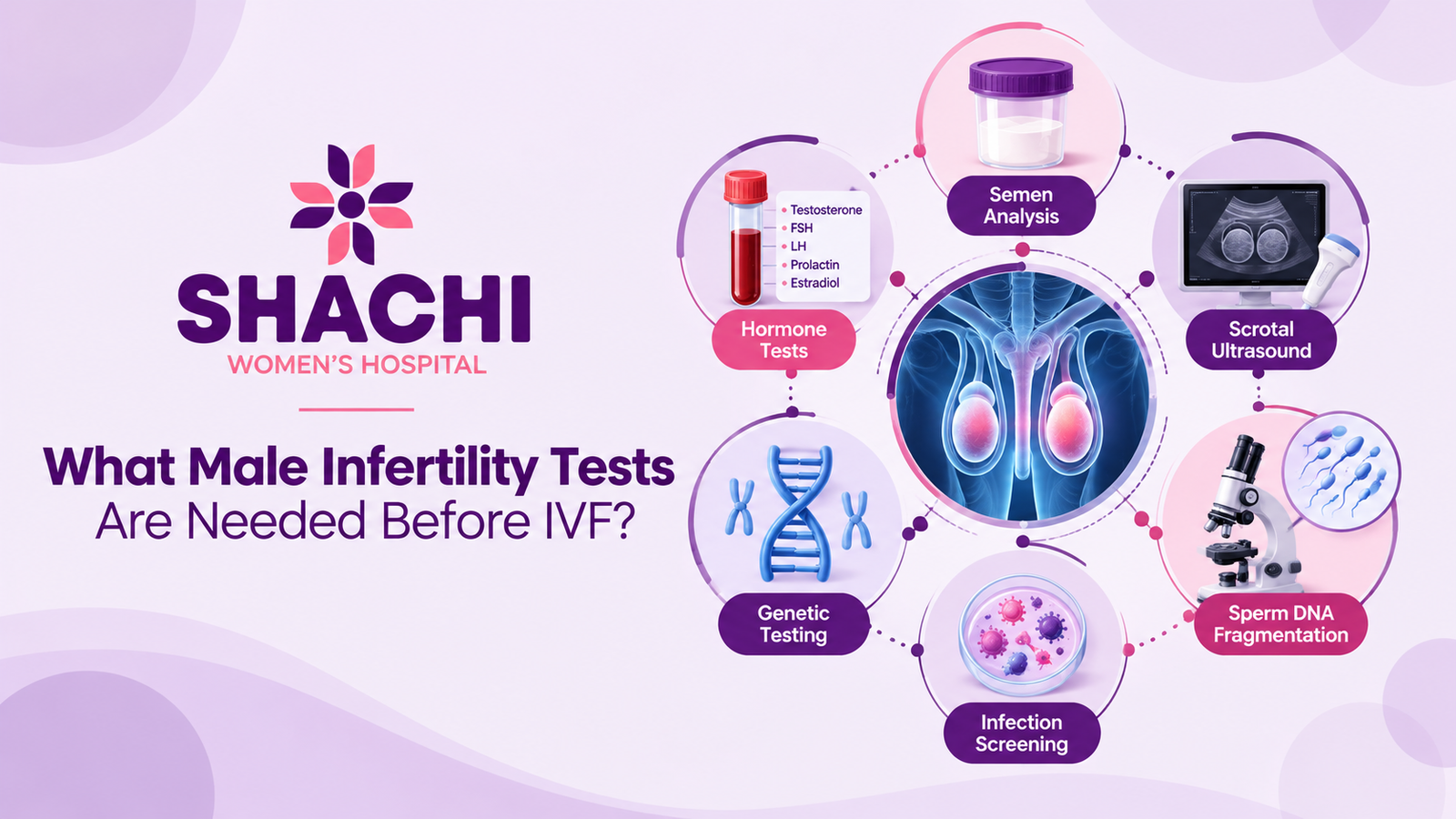
5 Male Infertility Tests Your Doctor May Recommend Before IVF
You won’t necessarily have all five. The doctor looks at your history and any old reports first, then decides. Think of this as options, not a checklist.
1. Semen Analysis to Check Sperm Health
Nearly everyone starts here. You give a semen sample, usually after two to five days without ejaculation, and the lab studies it under a microscope.
They’re checking how many sperm there are, how fast and how straight they swim, what they look like, and how much fluid came with them. Doctors call these counts 'motility', 'morphology', and 'volume'.
Don’t panic over one odd number. Sperm quality shifts with illness, stress, and even a recent fever, so a repeat sample a few weeks later is common.
2. Hormone Tests to Identify Imbalances
If the semen report looks off, or you’ve got symptoms like low sex drive, a blood test comes next. It looks at FSH, LH, and testosterone, which together control how the testicles make sperm. Prolactin gets added only when something suggests it’s worth a look.
The numbers tell the doctor where the trouble sits. Is the brain sending weak signals, or are the testicles not responding to them? The answer changes the treatment.
3. Physical Examination and Medical History
This one feels like a regular check-up with extra questions. Past surgeries, long-term medicines, smoking, alcohol, childhood infections, and any earlier attempts at conceiving all matter.
The doctor may also examine the testicles by hand. They’re often looking for a varicocele, which is a cluster of swollen veins that can raise the temperature around the testicles and hurt sperm production in some men.
4. Genetic Tests for Specific Fertility Problems
When a sperm count is very low, or the sample has no sperm at all, genes may be involved. Doctors then consider a karyotype, which looks at the chromosomes, and a Y-chromosome microdeletion test, which checks for missing pieces of genetic code tied to sperm production. If they suspect a blockage, a CFTR test may be added.
Most men never need any of this. It’s reserved for specific situations, and genetic counselling usually goes along with it so you understand what the results mean for you and for any child.
5. Specialised Sperm Testing When Required
Sometimes the standard report looks fine on paper, yet pregnancies keep failing. A sperm DNA fragmentation test can help in those cases. It measures damage to the DNA carried inside the sperm, and doctors tend to use it after repeated miscarriages or when nothing else explains the delay.
A careful doctor won’t order these just to be thorough. Each test should have a reason.
What Happens After Male Fertility Testing?
The reports go to your fertility specialist, who reads them next to the female partner’s results. Then you sit down and talk about options.
Depending on what showed up, the plan might be treating a hormonal or medical issue first, tweaking habits like smoking or heavy drinking, or moving ahead with IVF or ICSI. If there’s no sperm in the semen, surgical sperm retrieval may be discussed.
Whatever the result, you now have a direction. That’s worth a lot when you’ve been stuck in “why isn’t this working?” for months.
Where Can You Get Male Infertility Tests in Ahmedabad?
Fertility checks are stressful enough without knowing what you’re being tested for. It helps to have a doctor who explains why each test is being done and what the numbers mean.
At Shachi Women’s Hospital, couples can talk through their concerns and find out what evaluation is needed before IVF. The advice depends on each partner’s history and reports, so no two plans look alike.
To enquire about an appointment, call Shachi Women’s Hospital at 9090118080.